 Physics at Virginia
Overview
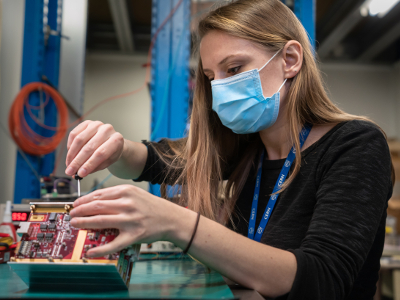
The experimental particle physics group at UVA is currently making major contributions to the CMS, NOvA, Mu2e, and LDMX experiments:
CMS
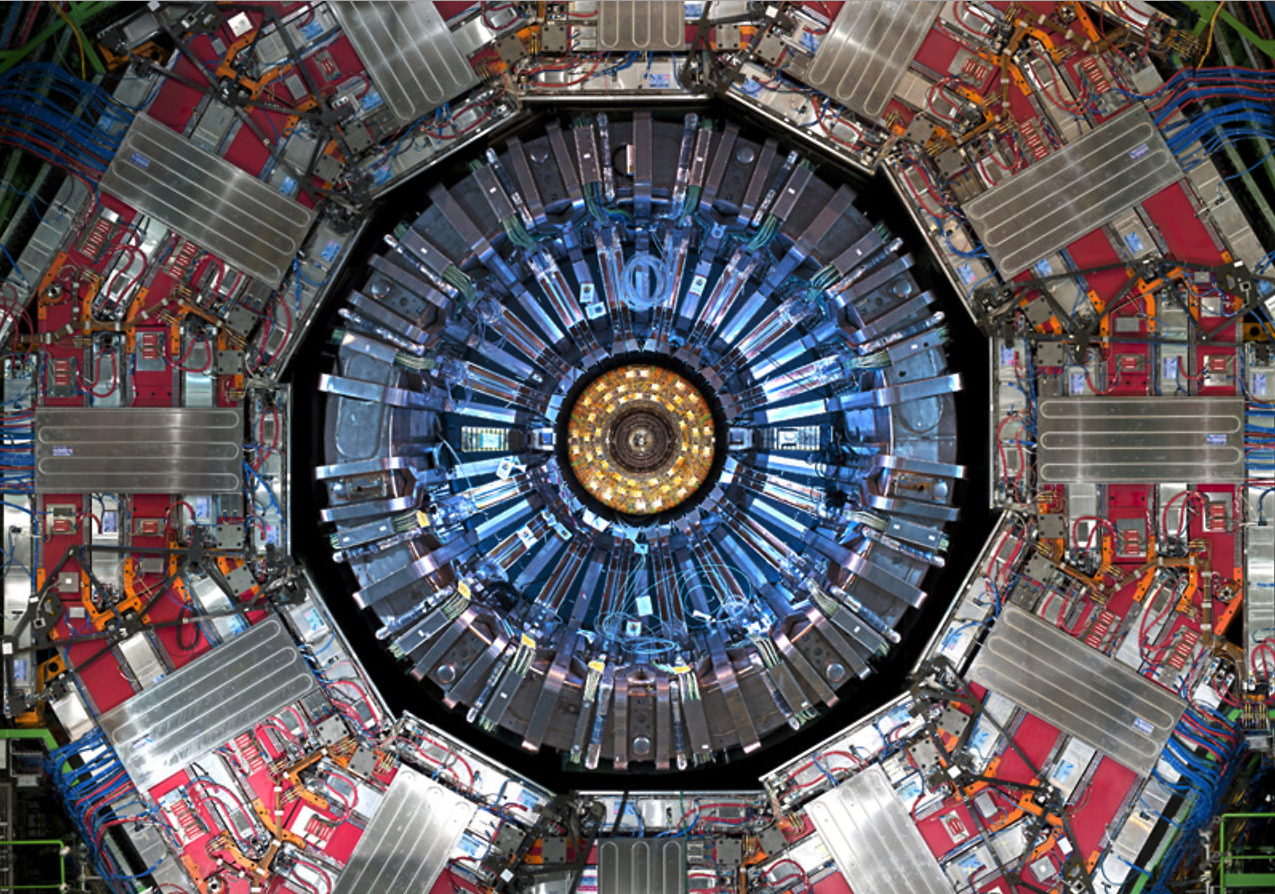 The Compact Muon Solenoid (CMS) experiment is one of two large general-purpose particle physics detectors built on the Large Hadron Collider (LHC) at CERN in Switzerland and France. The goal of CMS experiment is to investigate a wide range of physics, including the search for the Higgs boson, extra dimensions, and particles that could make up dark matter . The CMS group (Cox, Hirosky, Neu) has a wide range of physics interests, including Higgs boson and top quark studies, standard model measurements, and searches for supersymmetric particles and other exotic forms of matter. Our detector efforts have focused on the CMS electromagnetic and hadronic calorimeters and we are currently leading upgrade efforts for the CMS calorimeters and for a new dedicated precision timing detector for charged particle tracks in the High-Luminosity LHC era.
NOvA
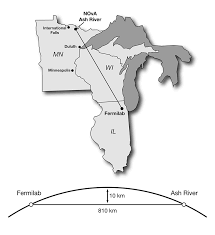 The NOvA (NuMI Off-axis ν Appearance) experiment is shedding light on one of nature's most elusive particles: neutrinos. Since the late 1990s, physicists have known that neutrinos exhibit a quantum mechanical behavior called oscillations. But this behavior is not predicted by the Standard Model of particle physics. NOvA is working to better understand these strange particles through precision measurements of their oscillation properties. The UVA group lead the effort to design and fabricate the NOvA Power Distribution System and is actively involved in physics analysis for this ongoing and world-leading neutrino experiment.
Mu2e
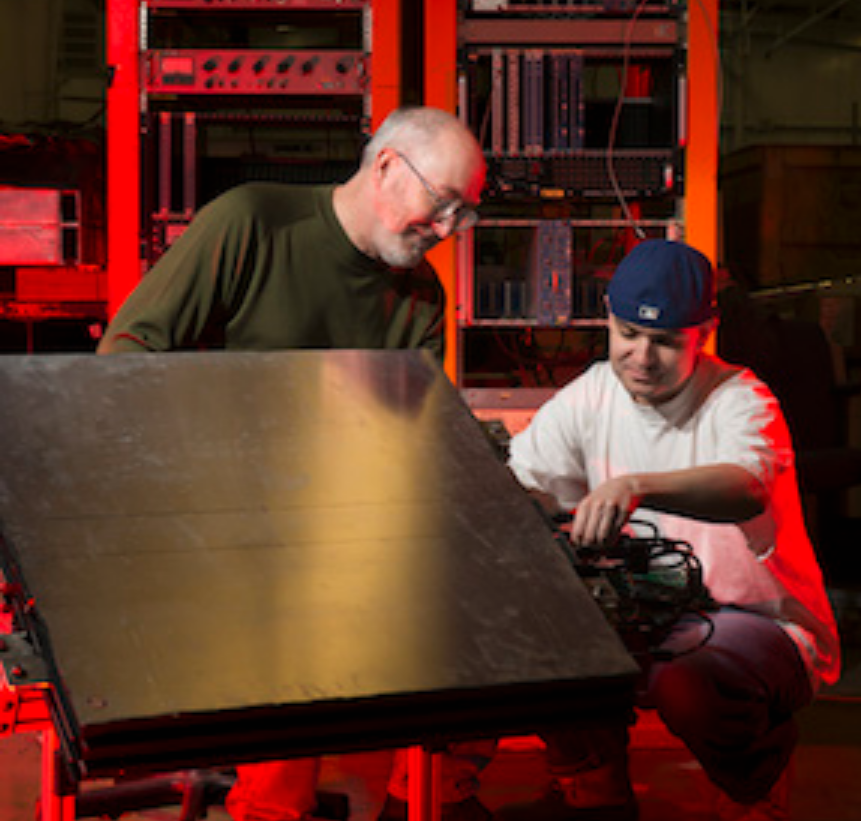 The Mu2e experiment will search for new physics through lepton-number violation: that is, muons decaying into electrons without any associated neutrinos. This is an example of a relatively low-energy experiment probing energy scales unattainable by any existing or proposed accelerator-based collider experiment. UVA leads the effort to design and fabricate one of the three main detectors for Mu2e, the Cosmic Ray Veto. The ongoing fabrication is one of the largest undertakings ever by the High Energy Physics group at UVA.
LDMX
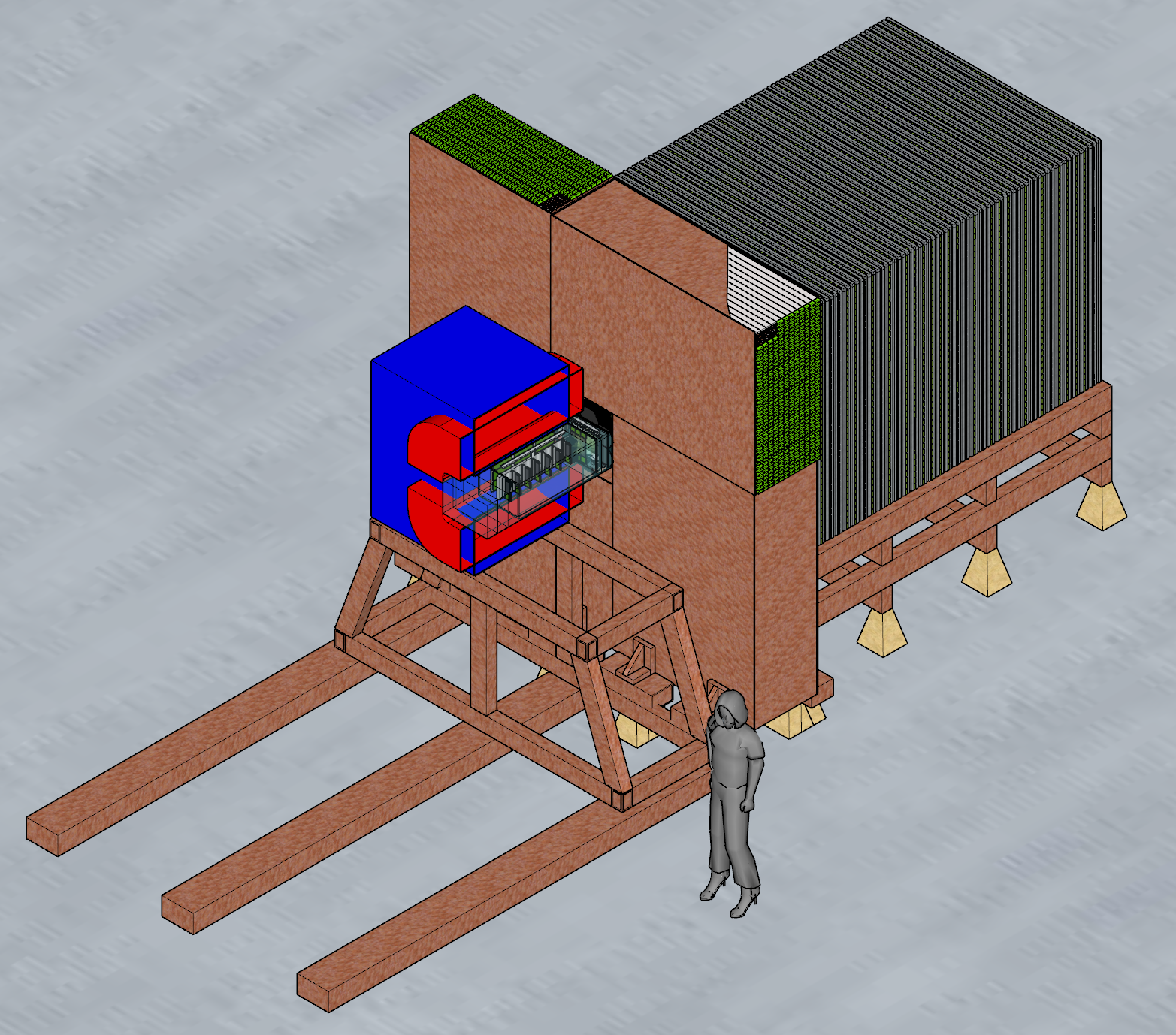 The constituents of dark matter are unknown, and the viable possibilities span a very large mass range. The region ~MeV to ~GeV is largely unexplored. If there is an interaction between this "light" dark matter and ordinary matter, then there necessarily is a production mechanism in accelerator-based experiments. The most sensitive way to search for this production is to use a primary electron beam to produce dark matter in fixed-target collisions. The Light Dark Matter eXperiment (LDMX) is a proposed experiment that has sensitivity to light DM in the sub-GeV range. In addition to the exciting possibility to detect and study the dark sector, the UVA group is interested in fabricating the hadronic veto calorimeter which plans to use a very similar technology as the Mu2e CRV which is currently being fabricated at UVA.
The Theoretical Elementary Particle Physics group acknowledges that the fundamental task of physics is to learn the rules of the basic interactions governing the behavior of matter and to search for new laws when present knowledge fails to answer the remaining mysteries of the observable universe. At the foundation of modern theories of particle physics is a deep and beautiful symmetry principle: the invariance of physical laws under symmetry transformations at every space-time point. Theories that show this symmetry are known as Yang-Mills or Gauge Theories. The Standard Model of Strong, Electromagnetic and Weak interactions is the most successful of these theories. It describes all known interactions of matter except gravity.
The Electroweak part of the Standard Model is being tested to a high degree of precision. The Strong interaction part, the Quantum Chromodynamics (QCD) Theory, which describes the interactions among the quarks, is being closely scrutinized, both perturbatively and nonperturbatively. The Standard Model is incomplete, however, since a number of fundamental puzzles, such as CP violation and the origin of masses, remain unsolved. The solutions to these problems probably lie outside the framework of the Standard Model. How does one solve the problem of masses? How does one solve QCD? These are among the topics under active investigation by UVa HEP theorists Hung and Thacker.
Personnel
 Edmond Craig Dukes
Professor Dukes’ research is in experimental Elementary Particle Physics where he has worked on experiments at several major accelerator laboratories in the world, and held visiting positions at: Brookhaven National Laboratory, CERN Lab in Geneva, Switzerland, Lawrence Berkeley National Laboratory, and the SSC. He is currently the head of the Frontier Physics Group at the University of Virginia. More>
 Robert Craig Group
What are the most fundamental pieces of our Universe? What are their properties and how do they interact with each other to form the structure and the phenomena that we observe? More>
 Robert J. Hirosky
Bob’s research explores questions in Elementary Particle Physics on the CMS Experiment (http://cms.cern.ch) at the CERN LHC Collider in Geneva Switzerland. Our group explores the limits of the Standard Model of particle physics on multiple fronts, including studies of the Higgs boson, searches for new physics signatures, and precision measurement. We are also actively engaged in R&D for detector design and the development of high performance electronics for detector systems. Our hardware efforts include electronics upgrades for the CMS Hadron ... More>
 Dustin M. Keller
Professor Keller conducts research in spin physics at the intersection of high-energy, nuclear, and condensed matter physics, with interests in hadron spin structure, physics beyond the standard model, spin-sensitive phenomena, and mapping the inner structure of composite spin systems. This research involves the study of quark and gluon dynamics as well as the study of spin degrees of freedom to probe polarized observables. This research could also be ... More>
 Cristina Mantilla-Suarez
Cristina Mantilla-Suarez is an experimental particle physicist seeking to understand the properties and interactions of the Higgs boson and the particle nature of dark matter. She is a member of the CMS experiment at the CERN Large Hadron Collider. Her research also explores the use of low cost but high intensity accelerator beam-lines to expand the search for new physics, in particular to search for dark matter particles with masses below the proton mass. Mantilla-Suarez is a Lederman postdoctoral fellow at Fermilab and will be joining UVA in the Fall of 2024.
More>
 Christopher Neu
Prof. Neu's research program focuses on the building blocks of the Universe and how those building blocks interact. He studies exotic forms of matter produced at the Large Hadron Collider (LHC) at CERN as a collaborator on the Compact Muon Solenoid (CMS) experiment.
His specific interests focus on the characterization of the Higgs boson. The recent discovery of the Higgs boson has solved a significant open question in modern physics: How do the fundamental particles obtain mass? The discovery of ... More>